The Theft and Struggle of the Black Eagle
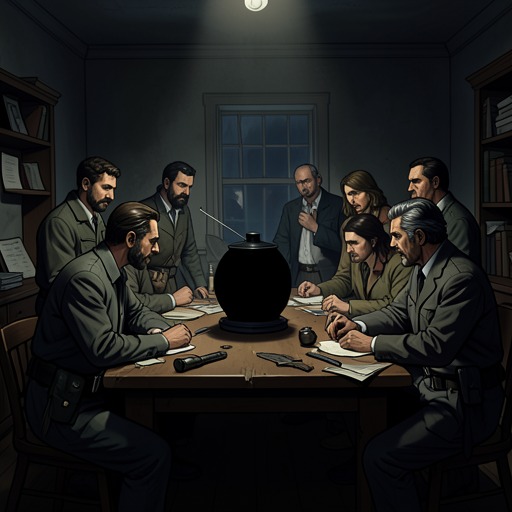
The Maltese FalconThe theft and pursuit of the Maltese Falcon are the hidden history connecting Brigid O’Shaughnessy, Floyd Thursby, Joel Cairo, Casper Gutman, and Captain Jacobi. The Falcon changes hands through a chain of expedient alliances and betrayals, while its uncertain route gives the competing parties reasons to deceive, pursue, and kill. Brigid’s account supplies the central sequence: a plan to take the Falcon from a Russian named Kemidov, a preemptive betrayal of Cairo, and a later quarrel with Thursby over the money he had promised her. The subsequent San Francisco pursuit turns that disputed history into an immediate case for Sam Spade.
The Kemidov plan and its first reversal
Brigid says she met Thursby in the Orient and came with him from Hong Kong to San Francisco. She describes herself as dependent on him and says he betrayed that dependence, but initially withholds the details. Later, she explains that she had agreed to help Cairo and Thursby obtain the Falcon from Kemidov, a Russian, in Marmora; Cairo’s promised payment to her was five hundred pounds.
The alliance broke when Brigid and Thursby learned that Cairo intended to take the Falcon for himself and leave them with nothing. They therefore acted against him first, as Brigid puts it, reversing the betrayal before he could carry it out. Their success did not secure her share of the prize. By the time they reached San Francisco, she says, Thursby had no intention of paying the seven hundred and fifty pounds he had promised her. He proposed going to New York to sell the Falcon and pay her afterward, but she believed he was lying. Her stated reason for hiring Spade was to find the Falcon and put herself in a position to bargain with Thursby.
Separate routes and competing pursuers
The Falcon’s movement did not simply follow Brigid and Thursby’s route. Gutman later says that, without their knowledge at the time, Brigid had given it to Jacobi in Hong Kong to bring to San Francisco aboard the La Paloma while she and Thursby took a faster boat. Gutman also says his group did not believe Thursby possessed the Falcon: they knew Brigid well enough to judge that, if only one of them knew its location, it was more likely to be her.
That separate transfer helps explain why the pursuit repeatedly changes direction. Gutman says Wilmer had located Thursby two days before the confrontation with Spade and had tried to follow him to a meeting with Brigid, but Thursby evaded him. On the night Thursby was killed, Wilmer found him at his hotel and brought him to Gutman. Gutman says he tried to negotiate, but Thursby remained loyal to Brigid; Wilmer followed him back to the hotel and killed him. Gutman presents the killing as a calculated effort to weaken Brigid’s protection and make her reconsider her conflict with the group, not as an attempt to seize a Falcon he believed Thursby carried.
The murders and the evidence in San Francisco
The Falcon struggle becomes entangled with the murder of Spade’s partner, Miles Archer. At the scene, the fence above Archer’s body has a ten-foot section of top rail torn loose, and Archer lies on a boulder partway down the slope. Spade reconstructs the shot as having been fired from the alley: Archer was standing with his back to the fence when the gunman fired, sending him backward through the broken rail and down the slope. The reconstruction distinguishes what the scene visibly shows from Spade’s account of how the fall occurred.
Police later connect the weapon to Thursby. Polhaus says the Webley-Fosbery revolver found at the scene was Thursby’s and that the slug recovered from Archer came from it. A bellhop at Thursby’s hotel had seen the unusual revolver in Thursby’s room that morning. This evidence gives the police a direct reason to treat Thursby as Archer’s killer, but the later account of the Falcon contest also places Thursby’s own death inside a larger sequence of pursuit and reprisal.
The attempted interception of Jacobi
Gutman’s account describes a later confrontation at Brigid’s apartment. His party found the apartment after searching through the day. When they rang and identified themselves at the door, they heard a window open; Wilmer went around to cover the fire escape. Jacobi was escaping through the alley with the Falcon under his arm. Wilmer shot at him repeatedly, but Jacobi continued away with the artifact, knocked Wilmer down, and escaped. A policeman was approaching, so Wilmer abandoned the chase and left by way of a neighboring building.
Brigid then told Gutman and Cairo that she had directed Jacobi to take the Falcon to Spade. To divert Spade before Jacobi could reach him, the group persuaded Brigid to telephone Spade’s office, while Wilmer went after Jacobi. Gutman says they had taken too long to arrange the diversion. The episode leaves the Falcon’s route dependent on narrow timing: the pursuers learn where Jacobi is going, but their attempt to intercept him is delayed by their own effort to use Brigid as a decoy.
What the contest reveals
The competing accounts make the Falcon’s custody more than a matter of possession. Brigid’s story presents each alliance as conditional: Cairo’s attempt to abandon his partners prompts their betrayal of him; Thursby’s refusal to pay her leaves her seeking leverage; and the Falcon’s separate passage with Jacobi keeps her and the pursuers from controlling the object’s movement. Gutman’s later account adds his group’s surveillance, failed negotiation with Thursby, and pursuit of Jacobi. Together, these disclosures show how the artifact’s path is reconstructed through statements by participants with interests of their own.
For Spade, the theft cannot be separated from the killings and the police investigation. He warns Gutman that he must be able to give the police a culprit when the reckoning comes, insisting that he has survived past clashes with the law because he could put a criminal before them. The Falcon’s pursuit thus creates both the case’s practical danger and its governing pressure: every hidden transfer or concealed alliance threatens to leave Spade unable to account for the deaths. The theft remains a contest over who can possess or bargain over the object, but also over who will bear responsibility when that contest is brought before the police.